

ISC2 Systems Security Certified Practitioner (SSCP) Exam Review – January 2026 Update
The Systems Security Certified Practitioner (SSCP) certification, administered by ISC2, is a globally recognised credential that validates an individual’s ability to implement, monitor, and administer information security controls.
The SSCP is aimed at hands-on security professionals — those working in operational, analyst, engineering, or junior architecture roles who are directly responsible for protecting systems and data within an organisation.
This review covers the exam structure, preparation strategy, exam-day experience, endorsement process, and post-exam reflections, updated for 2026.
Exam Structure and Content
As of 2026, the SSCP exam consists of:
- 150 multiple-choice questions
- 4-hour time limit
- Includes unscored (beta) questions
- Delivered via Pearson VUE (test centre or online)
The exam is based on seven domains from the ISC2 Common Body of Knowledge (CBK), each weighted according to its importance in real-world security operations:
SSCP Exam Domains
- Security Operations and Administration – 16%
- Access Controls – 15%
- Risk Identification, Monitoring, and Analysis – 15%
- Incident Response and Recovery – 14%
- Cryptography – 9%
- Network and Communications Security – 16%
- Systems and Application Security – 15%
The SSCP exam is designed to test practical, operational security knowledge rather than high-level governance. Expect scenario-based questions that assess how you would apply controls, respond to incidents, and secure systems in real environments.
Preparation for the Exam
Preparation for the SSCP requires a structured and disciplined approach due to the breadth of material covered.
What Worked for Me
- Official ISC2 SSCP Study Guide (essential)
- Supplementary textbooks covering individual domains
- LinkedIn Learning and YouTube for reinforcement and alternative explanations
- Regular practice exams to build confidence and exam stamina
Practice exams are especially important — not just to test knowledge, but to get comfortable with ISC2-style wording, which can be nuanced and intentionally challenging.
Additional Preparation Advice
- Join study groups or forums to clarify weak areas
- Reinforce theory with real-world examples
Ideally have 1–2+ years of hands-on experience in roles such as:
- Security Analyst
- Security Engineer
- Security Consultant
- Junior Cybersecurity Architect
Tip: The day before the exam, do a final domain review and complete one full practice test to validate readiness — don’t try to learn anything new.
Exam Experience
On exam day, arrive early to allow time for check-in and identity verification.
For my exam:
- Scheduled for 11:00
- Arrived at 09:30
- Provided two forms of ID
Had my photo taken and completed biometric scanning (palm/vein)
Once seated, you’re given 2 minutes to accept the NDA.
Failing to accept within this window can result in exam termination, so do this immediately.
During the Exam
Key things to remember:
- Read every question carefully — do not rush
- Manage time, but don’t panic if you’re unsure
- Use educated guessing:
- Eliminate clearly incorrect answers
- Choose the most practical and secure option
- Think like a security practitioner, not a textbook
All 150 questions are presented in sequence. Once submitted, the exam ends immediately and you’re escorted out to collect your belongings.
At that point, the proctor will hand you a pass/fail report.
- Pass: You receive a congratulations notice
- Fail: You receive domain-level feedback indicating where to improve
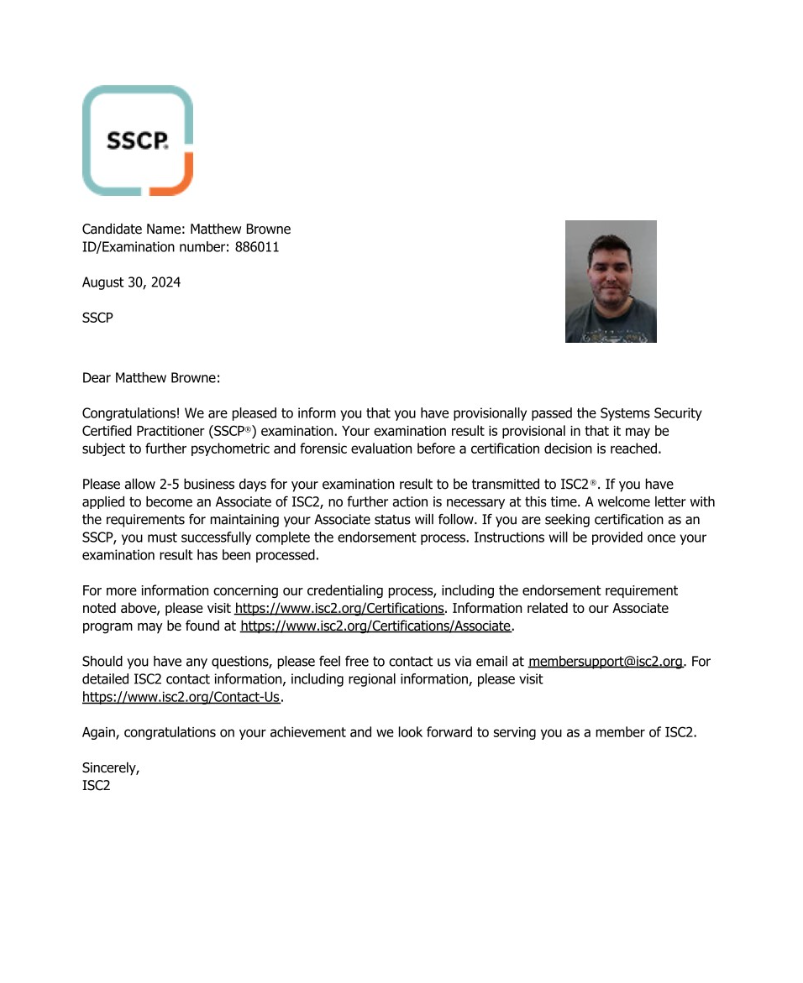
For my exam I was brought straight up to all 150 questions , when I submitted it said my exam ended and go down and do the walk to collect your belongings from your locker this adds an element of excitement but also pressure for the candidate the proctor then hands you a report which states Pass or Fail.
It will Look something like this if you Pass
 Or it will look something like this if you Fail
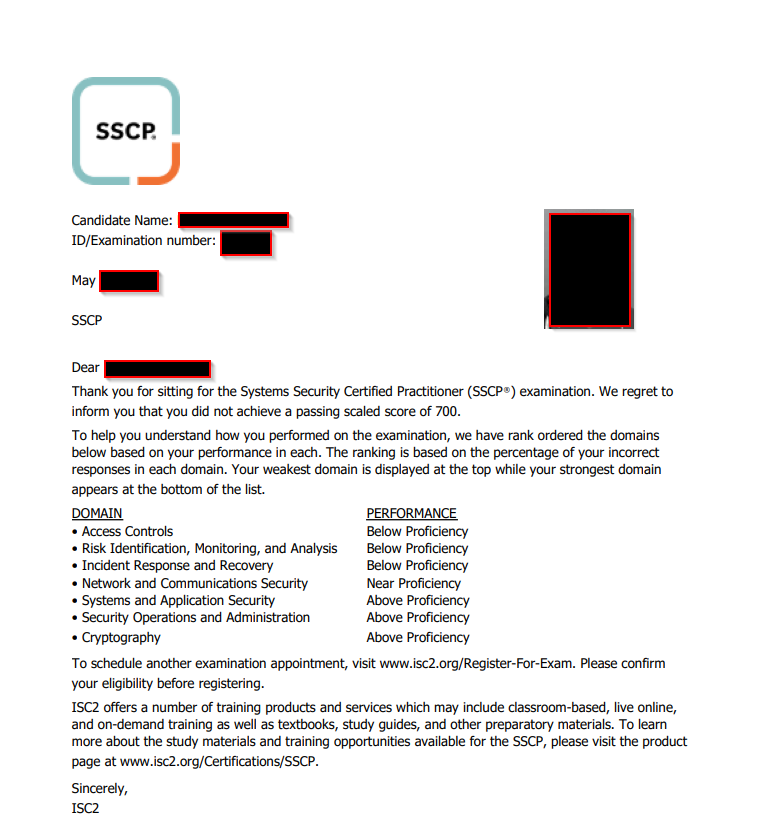
The fail report will provide you a indicator in terms of how you failed if you failed to re-study specific domains , if you pass you will receive a congratulation’s report.
Once this is complete the next thing you need to do is go through the endorsement Process , ISC2 will send you an email which looks something like this to continue onto the next stage.
Link for endorsement can be found on the ISC2 Website : https://www.isc2.org/

Once you complete the endorsement Progress ISC2 will send you an email which looks similar to this

You can check your status at any time it will look something like this
What this means is its been reviewed by your Endorser and is Awaiting review from ISC2 , this may take 4-6 weeks.

If your application is under review you may get an error if you have not provided enough information it may look like this , to resolve this you must reply back to ISC2 with the required information you will probably get an email that looks similar to this :

So once your application is submitted and has been accepted by ISC2 it may look like the below. also check your email for an automated message which will look like this :
for anyone That is going through the process this is your last step before you make your AMF Payment


Once you make your AMF payment on the ISC2 website you will then see on the bottom left your option to print your Certificate within your account , Once everything has been paid up you will also get notified by Credily with a Congratulation’s email.


Link to AMF : Info https://www.isc2.org/policies-procedures/amfs-overview
Your certificate will look something like this :

Do not forget you should also get a physical pack as well in the post.
As an ISC2 SSCP holder, you will receive:
- A digital certificate (downloadable)
- A Credly digital badge
- A physical welcome kit, delivered by post
If you pass, the next step is the ISC2 endorsement process.
What Happens Next
ISC2 emails you instructions to begin endorsement
- You submit professional experience details
- Your endorser reviews your application
Status updates may show:
- Awaiting Endorser Review
- Awaiting ISC2 Review
This review process can take 4–6 weeks.
If additional information is required, ISC2 will email you directly — respond promptly to avoid delays.
Once approved:
- You’ll receive confirmation via email
- You’ll be prompted to pay your Annual Maintenance Fee (AMF)
AMF Info:https://www.isc2.org/policies-procedures/amfs-overview
After AMF payment:
- Your certificate becomes downloadable in your ISC2 profile
- You’ll receive a Credly digital badge
- Your certification status becomes active
Post-Exam Reflection
Earning the SSCP validates your ability to operate effectively in real-world security roles. It enhances credibility, boosts confidence, and demonstrates practical security competence.
Looking back, this exam was a genuine learning curve. It was the first time I truly appreciated how challenging ISC2 exams can be, even at the practitioner level.
While ISC2 offers higher-level certifications, the SSCP is an excellent entry point into their ecosystem — it builds both subject mastery and exam technique, and it feels genuinely rewarding to complete.
Final Thoughts
The SSCP – Systems Security Certified Practitioner exam is demanding but absolutely worthwhile.
My advice:
- Study consistently
- Use multiple learning sources
- Lean heavily on LinkedIn Learning and YouTube
- Treat this as a journey, not just an exam
Whether you pass on the first attempt or not, the knowledge gained alone makes this certification valuable.
More Info below on ISC2 Website
https://www.isc2.org/certifications/sscp